
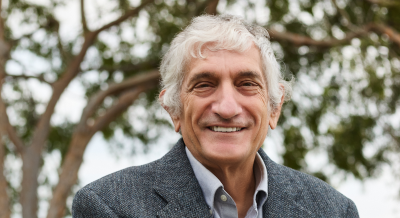
From prehistoric qubits to building a useful quantum computer—by John Martinis, 2025 Nobel Laureate in Physics
In the span of four decades, quantum computation has evolved from an intellectual curiosity to a potentially realizable technology. John Martinis will describe his thesis work on macroscopic quantum tunnelling and energy-level quantization that led to the Nobel Prize, as well as several other important experiments that advanced superconducting qubits. Nevertheless, the path toward a full-stack scalable technology is a work in progress. There are significant outstanding quantum hardware, fabrication, architecture, and algorithmic challenges that must be solved. In his talk John Martinis will show how the road to scaling could be paved by adopting existing semiconductor technology to build much higher-quality qubits and employing system engineering approaches.
John Martinis did pioneering experiments in superconducting qubits in the mid 1980’s for his PhD thesis. He has worked on a variety of low temperature device physics during his career, focusing on quantum computation since the late 1990s. He was awarded the London Prize in low temperature physics in 2014 for his work in this field. From 2014 to 2020 he worked at Google to build a useful quantum computer, culminating in a quantum supremacy experiment in 2019. He was awarded the John Stewart Bell prize in 2021. In 2023 he co-founded the startup Qolab to build a superconducting quantum computer. He was awarded the Nobel Prize in 2025. He is in Perth as part of the Forrest Research Foundation Distinguished Visiting Researcher program and will present a plenary lecture at the 21st Patras Workshop on Axions, WIMPs and Wisps, at The University of Western Australia, November 8-13.
Tickets are free, but registration is essential.